Kettlebell guide
How to do a kettlebell swing: form, mistakes and back safety
In short: The swing is a hip hinge, not a squat. Push your hips back, hike the bell between your legs, then drive your hips forward to stand tall and let the bell float to about chest height. Your hips move the bell, not your arms. Learn the hinge first, set up about a foot behind the bell, don't lean back at the top, and stop the set when your form slips or something hurts.
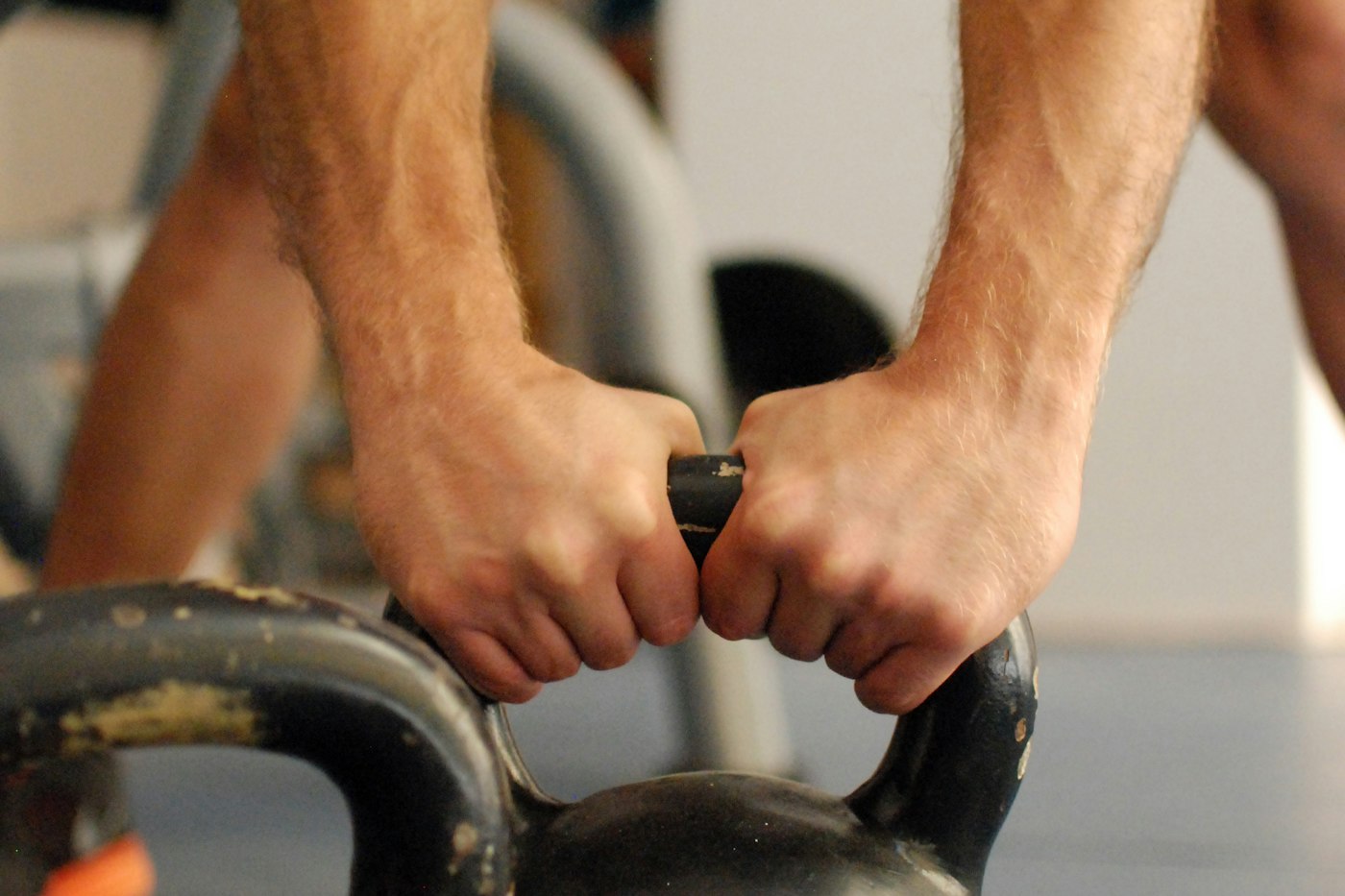
Learn the hip hinge first
Every good swing is built on the hip hinge: your hips move back and forward while your back stays long. Dan John describes it as "maximum hip bend and minimal knee bend. It is not a squat!"
The NSCA's progression for teaching the hinge has three steps:
- Back-to-wall hinge: stand about 12 inches in front of a wall, feet between hip- and shoulder-width apart, knees unlocked, and push your hips back until they touch the wall.
- Dowel hinge: hold a stick upright along your back so it touches your head, your mid-back and the base of your spine, and hinge without losing any of the three contacts.
- Kettlebell deadlift: hinge to pick up the bell from between your feet, then stand up by driving your hips forward.
ACE suggests moving on to the swing once you can do a loaded hip hinge with good form for about 12 to 15 reps.
The swing, step by step
- Set up. Stand about a foot behind the bell, feet about shoulder-width apart. Find your hinge first, then reach for the handle with both hands (StrongFirst; ACE).
- Hike. Hike the bell back between your legs, high, so your upper arms connect to your ribs and your forearms meet your inner thighs (StrongFirst). Dan John says to hike it "at your zipper."
- Drive. Snap your hips forward. "The strength to move the weight should come from the legs and hips, NOT the shoulders," writes ACE; the hip drive carries the bell to about chest or shoulder height.
- Stand tall. At the top you're a vertical plank: legs straight, glutes squeezed, arms straight out in front, standing at your full height without leaning back (Dan John; StrongFirst).
- Let it fall. Let the bell drop back toward your zipper and hinge again; the hinge loads the next rep (Dan John).
- Park it. To finish, hold your hinge while the bell swings back one last time, then set it down in front of you (StrongFirst).
Common mistakes and how to fix them
| Mistake | What it looks like | Fix |
|---|---|---|
| Squatting the swing | Your knees bend deeply and the bell moves up and down instead of back and forth. | Go back to the wall hinge: hips back, not down (ACE; Dan John). |
| Lifting with your arms | The bell rises like a front raise, with your shoulders doing the work. | Let your hips throw the bell; your arms just hold on (ACE). |
| Standing too far away and reaching first | You reach for the bell with your arms before you've hinged. | Start about a foot behind the bell and find your hinge before you reach. StrongFirst warns that reaching first can load your lower back. |
| Leaning back at the top | Your lower back arches as the bell floats. | Finish tall through your hips, and drive your feet into the floor instead of pulling with your shoulders (StrongFirst). |
| Swinging overhead | The bell goes above your head. | In this swing, the bell shouldn't go overhead (Dan John). Let it float to about chest height and guide it back. |
| Too heavy or too many reps | Your form falls apart in the last reps. | Choose a bell that lets you keep good form for the whole set (ACE), and end the set early. |
Are kettlebell swings bad for your back?
Done as a hip hinge, the swing is driven by your hips and legs. Several of the mistakes above shift the work to your lower back: StrongFirst warns that reaching for the bell before you hinge can load your lower back, and leaning back at the top puts the finish into your lower back instead of your hips.
If swings hurt your back:
- Stop the set. Don't push through pain.
- Go back to hinge drills and kettlebell deadlifts with a lighter bell, and film yourself from the side.
- Have a kettlebell instructor or another qualified coach look at your swing, in person or online.
- See a doctor or physical therapist if the pain lasts or keeps coming back, or comes with numbness, tingling or weakness in your legs.
If you already have back problems, ask a doctor or physical therapist before you start swinging.
Russian vs. American swing
The swing in this guide ends with the bell at about chest or shoulder height, as ACE teaches it. Dan John's rule for his swing program is short: "The kettlebell should not be brought overhead."
CrossFit does it differently. In a 2004 CrossFit Journal article, CrossFit founder Greg Glassman wrote that "at CrossFit we swing the kettlebell overhead while the kettlebell community swings to eye or shoulder height," and called the two versions the "Russian" and the "American" swing. His argument for going overhead: it nearly doubles the range of motion, and so the work done with each swing. If you're learning, start with the chest-height swing that ACE and Dan John teach, and master the hinge before anything goes overhead.
How many swings, and how heavy?
There's no single right number. Short sets with good form beat long sets that fall apart: choose a bell that lets you keep good form for the whole set (ACE). Which bell to start with is in What size kettlebell should I start with?. Experienced lifters go much higher: Dan John's 10,000 swing challenge is 500 swings a session for 20 sessions; see our guide to the challenge.
How Strongbell teaches the swing
We make Strongbell, so this part is about our own app:
- The swing, like each of its 23 exercises, has a video from one or more angles, written steps and the common mistakes to avoid.
- With Learn kettlebells as your goal, Kettlebell Foundations spends two weeks on the swing, the hinge first.
- In a workout, a coach's voice calls out every set and counts down your rests, over your music and with the phone locked. You log each set with one tap; Strongbell doesn't count your swings by itself.
- Swing practices: a daily 100 swings and 10 get-ups, 10,000 swings, a swing EMOM and a swing ladder.
- It runs on iPhone (iOS 18 or later) and Android (8.0 or later), free to download, with a 7-day free trial of Strongbell Pro.
Strongbell is not medical advice, and it doesn't replace a coach watching your swing.
Frequently asked questions
Why do kettlebell swings hurt my lower back?
Common causes are squatting instead of hinging, reaching for the bell before you hinge, leaning back at the top, or a bell that's too heavy. Stop, go back to hinge drills with a lighter bell, and have your swing checked. See a doctor or physical therapist if the pain doesn't go away.
How high should a kettlebell swing go?
To about chest or shoulder height, driven by your hips (ACE). In the Russian swing taught here, the bell doesn't go overhead.
Is the kettlebell swing a squat or a hinge?
A hinge. Dan John describes it as maximum hip bend and minimal knee bend, and ACE names squatting instead of hinging as a common mistake.
Are kettlebell swings good for beginners?
Yes, once you've learned the hip hinge. ACE suggests mastering a loaded hip hinge for about 12 to 15 reps with good form before you move on to swings.
What is the difference between a Russian and an American kettlebell swing?
The Russian swing stops at about chest or shoulder height; the American swing, used by CrossFit, takes the bell all the way overhead.
Read next
Sources
- The ACE Do it Better Series: The Two-handed Kettlebell Swing — Pete McCall, American Council on Exercise (ACE), CERTIFIED, January 2025
- Progressive Strategies for Teaching Fundamental Resistance Training Movement Patterns — Merrick Lincoln, Kaitlyn Ill and Matthew Ibrahim, NSCA Personal Training Quarterly 10.2 (2023): hip hinge progression
- The 2 Most Common Errors in Kettlebell Swing Set-up — Brett Jones, StrongFirst
- A Self-Correcting Drill for a Classic Blunder of the Kettlebell Swing — Brett Jones, StrongFirst: leaning back at the top of the swing
- The 10,000 Swing Kettlebell Workout — Dan John, T Nation (the current page is dated June 4, 2022)
- The Kettlebell Swing — Greg Glassman, CrossFit Journal 25, September 2004: why CrossFit swings overhead