
Kettlebell guide
Kettlebell training over 50 and 60: what weight and how to start
In short: From 55, Strongbell starts lifters one size lighter: a woman new to kettlebells at 6 kg (15 lb) for deadlifts and swings and 4 kg (10 lb) for presses, a man at 12 kg (25 lb) and 8 kg (20 lb); under 55, the same bells as at 30. In trials with people aged 59 to 79, supervised kettlebell training was well tolerated and built strength. Train two or three days a week, deadlift before you swing, and ask your doctor first.
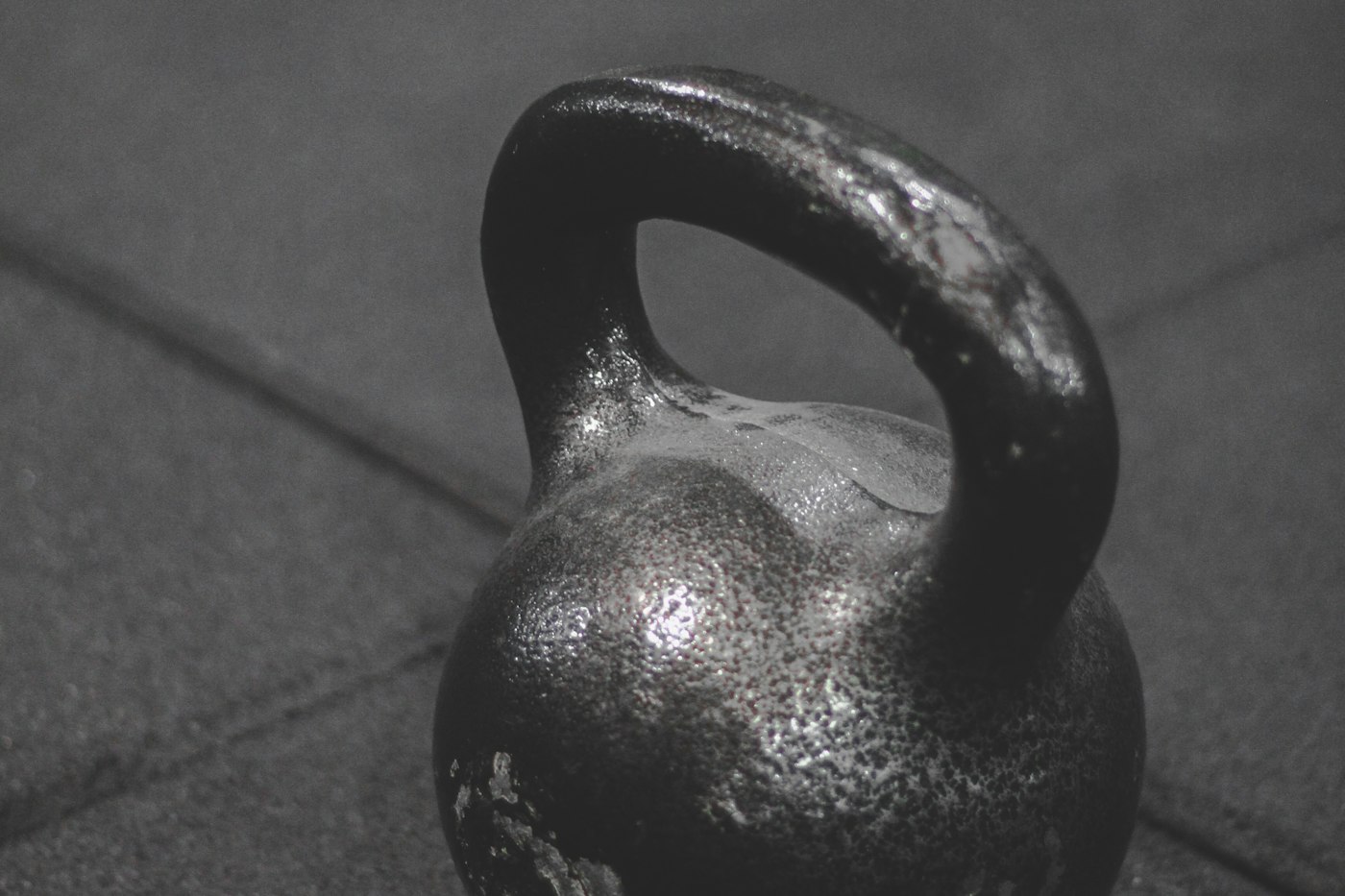
What size kettlebell to start with over 50, 60 and 70
Strongbell, our kettlebell app, starts lifters of 55 and older one standard size lighter than younger ones, and age changes nothing else. Under 55 the starting bells are the same as at 30. The first number is the bell for deadlifts, squats, swings, rows and carries; the second for presses, cleans and get-ups.
| Who | New to kettlebells | Some practice | Train regularly |
|---|---|---|---|
| Women, 50 to 54 | 8 / 6 kg 20 / 15 lb | 12 / 8 kg 25 / 20 lb | 16 / 12 kg 35 / 25 lb |
| Women, 55 and older | 6 / 4 kg 15 / 10 lb | 8 / 6 kg 20 / 15 lb | 12 / 8 kg 25 / 20 lb |
| Men, 50 to 54 | 16 / 12 kg 35 / 25 lb | 20 / 16 kg 45 / 35 lb | 24 / 20 kg 53 / 45 lb |
| Men, 55 and older | 12 / 8 kg 25 / 20 lb | 16 / 12 kg 35 / 25 lb | 20 / 16 kg 45 / 35 lb |
So a woman of 60 who has never trained with a kettlebell starts at 6 kg (15 lb) and 4 kg (10 lb), and a man of 65 at 12 kg (25 lb) and 8 kg (20 lb). Experience matters more than age here: if you've trained with kettlebells for years, read the right-hand column.
The lighter start is a cautious rule of thumb, not a limit. In the BELL trial, men and women aged 59 to 79 who hadn't been active enough trained with bells from 4 kg up and were given an 8 kg bell for their home sessions. And whatever your age, StrongFirst's warning holds: "kettlebells feel a lot heavier than advertised."
Work out your bells
The calculator uses the same rules as Strongbell. It starts at age 60: change it to yours, and tick the bells you already own to see which to use for each lift.
Are kettlebells safe for seniors?
For most healthy older adults, yes, when the bell starts light and gets heavier gradually. The National Strength and Conditioning Association (NSCA), in its 2019 position statement on resistance training for older adults, calls countering muscle disuse through resistance training "a powerful intervention" against the loss of muscle strength and mass that comes with age, and sets out to "prevent or minimize fears" that keep older people from it.
Two trials have tested kettlebells in this age group:
- The BELL trial (Australia, 2022). 32 men and women aged 59 to 79 who hadn't been active enough did three months of hardstyle kettlebell training: three supervised 45-minute classes a week plus home exercises twice a week. They came to 91.5 % of the sessions, and there were four non-serious adverse events. Grip strength rose by 6 to 7 kg, the six-minute walk by about 42 metres (46 yards) and their best deadlift by 16 kg, and they climbed stairs and got up from the floor faster.
- A trial in Taiwan (2018). 33 women aged 65 to 75 with sarcopenia, age-related muscle loss, were split into two groups. The kettlebell group trained for 60 minutes twice a week for eight weeks; afterwards it had more muscle by the trial's sarcopenia index, and a stronger grip and back, than the group that didn't train, and the gains held four weeks after the training stopped.
Both trials were supervised. The BELL trial left out people with uncontrolled heart or lung disease, recent surgery or injury, or conditions that limit hard exercise, and asked everyone else for their doctor's clearance. The NHS gives the same advice to everyone over 65: "Speak to a GP first if you have not exercised for some time, or if you have medical conditions or concerns." That includes osteoporosis, a heart condition, a joint replacement or problems with balance; a physical therapist can show you which lifts suit you.
How often to train after 60
The CDC says that at 65 or older "you need aerobic, muscle-strengthening, and balance activities each week": at least 150 minutes of moderate activity such as brisk walking, muscle-strengthening on at least two days that works all the major muscle groups (legs, hips, back, abdomen, chest, shoulders and arms), and activities that improve balance. The NHS asks adults over 65 to do activities that improve strength, balance and flexibility on at least two days a week.
Two or three kettlebell sessions a week, with a day off in between, cover the strength part: a hinge, a squat, a row, a carry and a press work all of those muscle groups, and one-arm carries and the get-up ask for balance too. The Taiwan trial trained twice a week, the BELL trial three times.
How hard? The NHS says to do strength exercises "to the point where you need a short rest before repeating the activity." End a set while your form is still clean, not when you can't lift the bell any more.
The first kettlebell exercises to learn
Start with lifts done slowly and close to the body, and learn the swing once the deadlift feels solid. All of these are among Strongbell's 36 exercises.
- Deadlift. With the bell between your feet, push your hips back with a long back and stand up. It teaches the hip hinge, the movement behind lifting anything from the floor and behind the swing.
- Goblet squat. Hold the bell at your chest and sit down between your heels. Squat to a chair or bench behind you at first, and stand up from it.
- Suitcase deadlift and farmer carry. Lift a bell at your side, then walk with it: grip, posture, and the shopping bags.
- Bent-over row. Hinge forward with one hand on a bench or chair and pull the bell to your hip.
- Glute bridge. On your back with the bell on your hips, lift them off the floor.
- Halo. Circle a light bell around your head to loosen your shoulders.
- Half-kneeling press. If your shoulders allow it: one knee down, press the lighter bell overhead.
- Two-handed swing. ACE suggests moving on to swings once you can do a loaded hip hinge with good form for about 12 to 15 reps. Step by step: How to do a kettlebell swing.
- Turkish get-up. Getting down to the floor and back up, one step at a time. Learn it without a bell first, as the BELL trial did.
A sample first week
An example of where to start for someone new to kettlebells: two days a week, with at least a day between them, and the same workout both days. It isn't a prescription. If a weight or a movement doesn't feel right, use a lighter bell or leave it out.
| Exercise | Sets and reps | Bell |
|---|---|---|
| Halo | 2 × 5 each way | Press bell |
| Deadlift | 3 × 8 | Swing bell |
| Goblet squat to a chair | 3 × 6 | Swing bell, or the press bell at first |
| Bent-over row | 2 × 8 each arm | Swing bell |
| Glute bridge | 2 × 10 | Swing bell |
| Farmer carry | 3 × 30 seconds of walking | Swing bell, one hand then the other |
Rest a minute or two between sets. When every set feels easy with clean form, add a set or a few reps; after two or three weeks, start practising the swing with your deadlift bell. Which bell is your swing bell and which your press bell: the table at the top, or the calculator.
How Strongbell plans for older lifters
We make Strongbell, a kettlebell workout app for iPhone and Android, so this part describes our own product. It has no separate program for older lifters. What it does:
- When you set it up, it asks your sex and age (on iPhone it can read them from Apple Health if you allow it) and from 55 suggests bells one size lighter, as in the table above. It plans with the bells you own, in kilograms or pounds.
- Choose Learn kettlebells as your goal and the first two weeks teach the swing, the hinge first. Sets stay short, and fast overhead lifts stay out until you know the shapes.
- You choose 2 to 5 days a week and 15, 20, 30 or 45 minutes a workout.
- Every exercise has a video from one or more angles, written steps and the common mistakes to avoid. A coach's voice calls out each set and counts down your rests, with tips on how to move, breathe and recover.
- Finish your sets as planned twice in a row and it offers the next bell you own or more reps, one step at a time.
- You see the first week before you subscribe. Strongbell Pro unlocks the app: yearly with a 7-day free trial, or monthly. No account, no ads.
Strongbell is not medical advice, and it doesn't replace your doctor's OK or a coach watching your form.
Frequently asked questions
What size kettlebell should a 60 year old woman use?
By Strongbell's rules, a woman of 60 who is new to kettlebells starts at 6 kg (15 lb) for deadlifts, squats and swings and 4 kg (10 lb) for presses and get-ups. With some practice, 8 kg (20 lb) and 6 kg (15 lb); if she trains regularly, 12 kg (25 lb) and 8 kg (20 lb).
What size kettlebell should a man over 60 use?
A man over 60 who is new to kettlebells starts at 12 kg (25 lb) for deadlifts, squats and swings and 8 kg (20 lb) for presses and get-ups, by Strongbell's rules. With some practice, 16 kg (35 lb) and 12 kg (25 lb); with regular practice, 20 kg (45 lb) and 16 kg (35 lb).
What is the best kettlebell weight for a woman over 50?
Between 50 and 54, the same as for younger women: 8 kg (20 lb) for swings and deadlifts and 6 kg (15 lb) for presses if you're new to kettlebells. From 55, Strongbell starts one size lighter, at 6 kg (15 lb) and 4 kg (10 lb).
Are kettlebell swings safe for seniors?
They can be, once you can deadlift the bell with good form: ACE suggests about 12 to 15 good loaded hip hinges before you start swinging. Older adults in the BELL trial learned it in supervised classes. If you learn at home, start light, film yourself from the side and have your swing checked when you can.
Is it too late to start kettlebells at 70?
The two kettlebell trials took people up to 75 and 79, and both found strength gains within two or three months. Ask your doctor first, start with the lightest bells in the table and learn the deadlift before the swing.
Read next
Sources
- Older Adult Activity: An Overview — Centers for Disease Control and Prevention (CDC), December 4, 2025: weekly activity for adults 65 and older
- Physical activity guidelines for older adults — NHS, last reviewed August 15, 2024
- Resistance Training for Older Adults: Position Statement From the National Strength and Conditioning Association — Fragala MS et al., Journal of Strength and Conditioning Research 33(8): 2019–2052, 2019
- Effects of supervised high-intensity hardstyle kettlebell training on grip strength and health-related physical fitness in insufficiently active older adults: the BELL pragmatic controlled trial — Meigh NJ et al., BMC Geriatrics 22: 354, 2022; the lead author is a physiotherapist and kettlebell instructor
- Effects of 8-week kettlebell training on body composition, muscle strength, pulmonary function, and chronic low-grade inflammation in elderly women with sarcopenia — Chen HT et al., Experimental Gerontology 112: 112–118, 2018
- The ACE Do it Better Series: The Two-handed Kettlebell Swing — Pete McCall, American Council on Exercise (ACE), CERTIFIED, January 2025
- What kettlebell sizes do I need? — StrongFirst: starting kettlebell sizes for women and men, on its kettlebell page